10 Best Super Stockist Business Opportunities in India (2026)

A lot of people who want to enter the distribution business start by looking for a brand to distribute. But there is another role in the supply chain that works at a different level: the super stockist.

A super stockist usually keeps products supplied by a company and distributes them to a network of distributors. Those distributors then take the products to retailers and, ultimately, customers.

The usual flow is:

Company → Super Stockist → Distributor → Retailer → Customer

This means the job is not limited to selling products. Stock planning, warehouse management, payments, transportation and relationships with distributors are all part of the business.

If you are researching super stockist opportunities in India, the first thing to understand is that there is no single category that works for everyone. Your location, available capital, warehouse facilities and the company’s distribution model all matter.

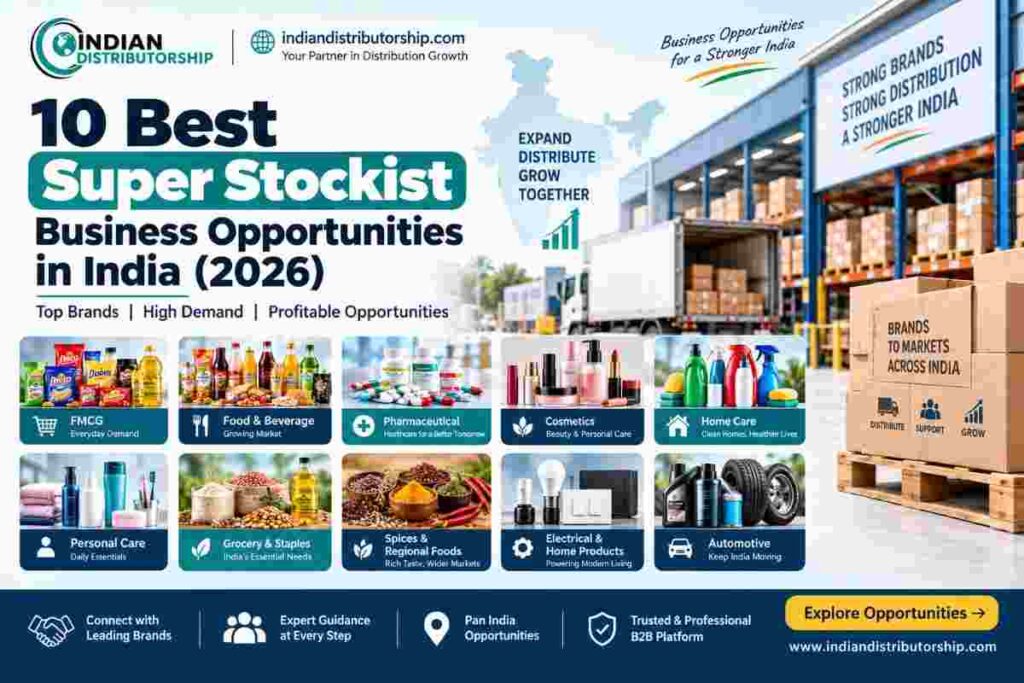
Here are 10 categories worth exploring in 2026.

Super stockist business opportunities in India 2026

1. FMCG Super Stockist

FMCG is one of the first categories people consider when searching for a super stockist business.

The range is large. It can include packaged food, grocery items, personal care, home care, snacks and everyday household products.

The advantage is simple: these are products people buy regularly. But regular demand does not automatically make every opportunity profitable. A new or weak brand may still struggle to move stock.

If you are considering an FMCG super stockist opportunity, look at the distributor network already operating in your area, expected stock levels, sales targets and payment terms.

2. Packaged Food and Snacks

Biscuits, namkeen, chips, sauces, ready-to-eat food and other packaged products are another area where companies may build distributor networks.

For this category, stock rotation deserves particular attention. Products with a limited shelf life can create problems if sales are slower than expected.

Ask the company how it handles expired or damaged stock and whether it provides any replacement support.

3. Beverage Distribution

Beverages include packaged water, juices, soft drinks, energy drinks and other non-alcoholic products.

The business can involve regular orders, particularly where a brand has established demand. At the same time, transportation and storage need careful planning because beverages can take up considerable warehouse space.

Before taking an opportunity, understand the territory, distributor coverage, delivery arrangements and seasonal demand.

4. Pharma Super Stockist

A pharma super stockist works with pharmaceutical and healthcare products and operates under stricter requirements than many general consumer-product businesses.

Depending on the products, you may need specific licences, suitable storage arrangements and other regulatory approvals.

The opportunity should therefore be evaluated from both sides: commercial potential and compliance. If you are new to pharmaceutical distribution, understand the applicable requirements before committing your capital.

5. Cosmetic Super Stockist

Skincare, haircare, grooming, personal hygiene and beauty products fall into this broad category.

A cosmetic super stockist may have access to a wide range of products, but product movement can differ considerably between markets. A brand that sells well in one city may have limited demand elsewhere.

Check the existing distributor network, product shelf life, return policy, marketing support and territory terms before making a decision.

6. Home Care Products

Cleaning and household products are another part of the FMCG market. These can include detergents, dishwashing products, floor cleaners, toilet cleaners and laundry products.

Because many of these products are used regularly, repeat purchases are possible when the brand has good market coverage.

For a super stockist, however, the important question is how quickly distributors are actually buying the stock. Slow movement can tie up working capital even when the product itself has a large potential market.

7. Personal Care and Wellness

Personal care products such as soaps, shampoos, hair oils, oral-care products and skincare items can also be distributed through a super stockist network.

Some companies may combine personal care with wellness or healthcare products.

When researching this segment, don’t look at the product alone. Find out how the company plans to build distribution in your territory and whether there is already demand from local distributors and retailers.

8. Grocery and Staples

Rice, flour, pulses, edible oil, sugar, salt and other staple products have a broad market across India.

The challenge is that high sales turnover does not necessarily mean high profit. Some grocery products operate with relatively tight margins, so stock movement and working-capital management become very important.

A good evaluation should therefore consider the complete calculation rather than only the purchase and selling price.

9. Spices and Regional Food Products

Masala, blended spices, pickles, papad, regional snacks and other specialty food products can provide opportunities for brands that are trying to enter new markets.

This can be particularly relevant for regional companies looking to expand beyond their existing territory.

If you explore this category, pay attention to shelf life, supply consistency, distributor demand and competition from established local brands.

10. Consumer Electrical and Home Products

Not every super stockist opportunity has to be in FMCG.

LED lights, electrical accessories, switches, small appliances and selected home products can also be distributed through channel networks.

Here, the business works somewhat differently. Warranty, replacement, product certification and after-sales service can affect both the distributor relationship and your working capital.

Make sure these responsibilities are clearly explained before taking the appointment.

How Much Investment Is Needed for a Super Stockist Business?

There is no universal figure for super stockist investment.

The money required depends on the company’s opening-stock requirement, territory, product category and the amount of working capital you need to keep available.

Your capital may go towards:

  • Initial inventory
  • Warehouse rent or deposit
  • Transportation
  • Staff
  • Distributor credit
  • Billing and inventory systems
  • Applicable registrations and licences
  • Security deposit, if required

In many cases, working capital is more important than having an expensive office. You need enough money to keep the stock moving while managing payments from distributors.

Always ask the company for the actual commercial requirement instead of relying on a generic investment figure.

What Is the Super Stockist Margin?

There is no fixed super stockist margin across the market.

The margin can change according to the product, company, territory, sales volume and commercial arrangement.

More importantly, gross margin is not the same as profit.

Suppose your business generates ₹20 lakh in monthly sales at a 6% gross margin. The gross margin would be ₹1.2 lakh. From that amount, you may still have warehouse, salary, transport, finance and other expenses.

That is why a lower-margin business with fast stock movement may sometimes have a different financial result from a higher-margin business with slow-moving products.

What Are the Super Stockist Requirements?

Requirements vary from one company to another, but a company may look for:

  • Adequate working capital
  • Warehouse facilities
  • GST and business registration
  • A business bank account
  • Transportation arrangements
  • Inventory management capability
  • Distributor or market connections
  • Relevant licences for regulated products

If you are applying for a pharma super stockist opportunity, for example, the requirements can be different from those for an FMCG business.

How to Become a Super Stockist?

If you are searching for how to become a super stockist, don’t start by paying a company simply because the brand is popular.

1. Choose the category

Decide whether you want FMCG, food, beverages, pharma, cosmetics, personal care, home care or another product category.

2. Choose your market

Decide which city, district or region you can realistically handle.

3. Find suitable companies

Look for companies looking for super stockist appointments in your preferred category and territory.

4. Understand the commercial terms

Ask about opening stock, margin, distributor margin, sales targets, payment terms, territory and replacement policies.

5. Verify the company

Check the company’s official business details, website, products and existing market presence.

6. Read the agreement

Make sure the appointment terms, territory, targets, payment conditions and stock policies are clearly mentioned in writing.

How to Get Super Stockist Opportunities?

There is no single way to find a super stockist appointment.

You can approach manufacturers directly, speak with people already working in the distribution industry, or use B2B platforms that list business opportunities.

If you are searching for how to get super stockist opportunities, start with the category and territory rather than searching only for famous brands.

Indiandistributorship.com helps business owners explore opportunities related to Super Stockist, Distributorship, C&F, and Dealership.

What Should You Check Before Joining a Company?

Before putting money into any super stockist opportunity, get clear answers to these questions:

  • Is the territory actually available?
  • How much opening stock is required?
  • What is the margin and incentive structure?
  • What is the monthly target?
  • What is the distributor’s margin?
  • Who pays transportation costs?
  • How is expired or damaged stock handled?
  • Is there any territory protection?
  • What support will the company provide?
  • Are all terms included in a written agreement?

These questions can save you from choosing an opportunity based only on a high margin or an attractive sales pitch.

Frequently Asked Questions About Super Stockist Business

Is a super stockist the same as a distributor?

No. A super stockist generally supplies products to distributors, while a distributor usually supplies retailers or other downstream customers. The exact structure can vary by company.

How much money do I need to become a super stockist?

There is no fixed amount. It depends on the company, category, territory, stock requirement and working capital needed for the business.

What is a good super stockist margin?

There is no single margin that can be called good for every business. Stock movement, operating costs, payment terms and total profitability should be considered along with the margin.

Can I become an FMCG super stockist?

Yes, if a company is appointing super stockists in your territory and you meet its commercial and infrastructure requirements.

How can I find FMCG companies looking for super stockist?

You can contact FMCG manufacturers directly, use industry contacts or explore B2B business opportunity platforms. Always verify the company and appointment terms before investing.

Can I become a pharma or cosmetic super stockist?

Yes, subject to the company’s requirements and any licences or regulations applicable to the products.

Final Thoughts

A super stockist business is mainly about managing the link between a company and its distributor network. Having enough capital is important, but it is only one part of the picture.

Before choosing an opportunity, look at the product’s demand, stock movement, territory, distributor network, margin, payment terms and company support.

If you are exploring super stockist opportunities across India in 2026, take time to compare the complete business terms and verify the company before making an investment.

Explore Super Stockist, Distributorship, C&F and Dealership Opportunities Across India with Indiandistributorship.com

Scroll to Top